Why Paper?
As the years pass and one travels down the ever-stretching road between then and now, certain signals from the past announce themselves. They arrive like roadside billboards you somehow missed the first time around, or postcards from the past that find you mid-stride on the walk to, say, your studio. They appear quietly, and small puzzle pieces begin snapping into place, even the ones you didn't know belonged to the same puzzle, creating a clearer picture of who you were and who you have become.
As an artist who has long surrounded herself with paper, always more paper, books, magazines, scissors, and glue, those signals have caused me to pull over and take notice.
What is it about paper?
In many an artist statement I've written about its transformative qualities. With a cut and a fold, magic can happen. Ta-da! But still, what is it about paper?
I have often told the story of my father returning home from his workday at IBM and presenting me with a model of a mainframe computer. I was four years old and utterly captivated by this marvel. No, not the computer, nor how it would forever change our lives. Rather, it was the perfectly folded miniature structure, printed in hushed greys, olives, and blues (of course), its colors saturated into matte, creamy cardstock that felt like velvet beneath my small fingers. It filled me with awe.
Once I came to my senses, I promptly placed it into the kitchen of my doll Penny Bright, who, while not much of a cook, was always in desperate need of additional counter space.
My father, who authored several books on Fortran in the early 1960s, may not have fully appreciated my creative repurposing. But the memory of that model has never left me. I've searched for one ever since, but have never found another.
I could wander off here and write about the remarkable life of a single sheet of paper. How it can become currency, a birth certificate, a love letter, a passport, a child's drawing tucked into a drawer for fifty years. How something so ordinary can quietly carry the weight of an entire life.
But let's get back to more of the magic, the magic that enchanted me.
A year or two after that paper model entered my world, another paper wonder arrived.
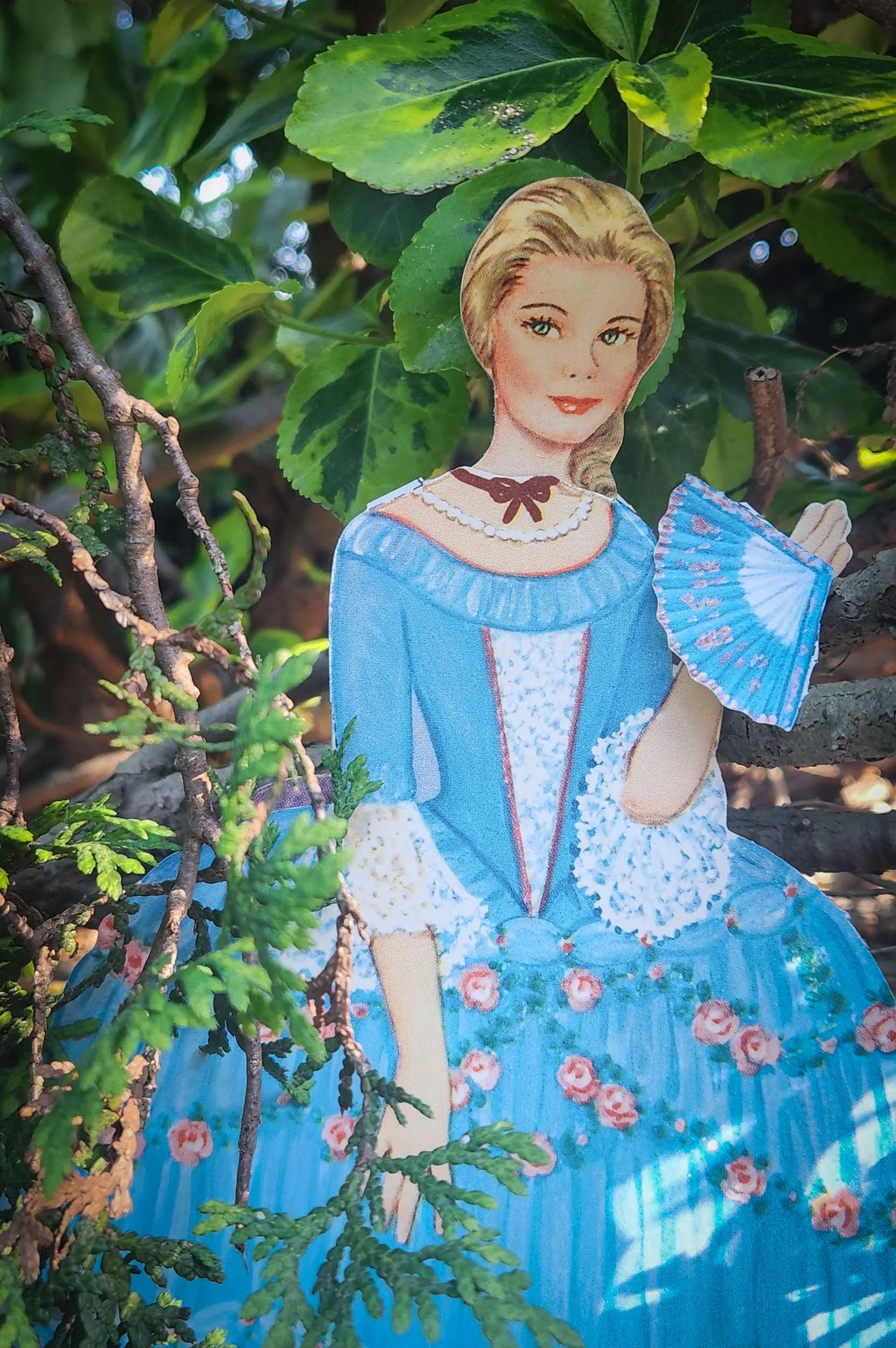
Betsy wearing her favorite dress in the box.
I was recovering from a tonsillectomy and the removal of those ever-mysterious adenoids. My days consisted of popsicles, television, and a few new gifts intended to make the whole miserable business a little more bearable. One of them was a box of paper dolls: Betsy Ross and Her Friends. Betsy, Tom, Dolly, and John.
Once I freed the figures from their cardboard prison, they could finally stand on their own, thanks to little cardboard stands. I spent hours carefully releasing the clothes from their perforated sheets, building wardrobes of dresses, coats, hats, and the occasional hand fan, dressing and redressing them by folding the tiny tabs over their shoulders and around their waists, imagining where they would go now that they were properly dressed. But bedtime was when the real magic began.
Perhaps it was the lingering effects of surgery and whatever marvelous anesthesia they used in those days, or simply the boundless imagination of a five-year-old, either way, each night Betsy and her friends slipped free from their cardboard stands and wandered into the woods behind our house.
Those woods became their kingdom.
While asleep, I roamed the woods with them. The velvets and brocades printed in pastel inks became sumptuous textures in the moonlight. Betsy's and Dolly's gowns swished through the trees, and tiny twigs snapped beneath their velvet slippers. I don’t recall what Tom and Johnny did, but no matter. By morning, they had quietly returned to their box. I knew then, and part of me still knows now, that they continue to reside in those woods on Eden Road.
It never occurred to me to question any of this. Paper could come alive. A single sheet could hold stories and secrets. So, without a doubt, a few "printed" figures could leave my bedroom and slip into an enchanted realm just beyond the edge of the yard.
Looking back, I realize that those paper dolls were doing far more than keeping me company while I recovered from surgery. They were transporting me somewhere else. Paper isn't merely a surface. It's a doorway. An invitation. A stage waiting for someone to begin the story.
Only recently did I realize that Tom was not Betsy's husband, nor were Johnny and Dolly their children. They were simply her friends, mine as well. Looking back, I realize this is when I first to learned to appreciate the magic - paper is never just paper.